
Materials Matter: Exploring the Latest Zirconia and E-max Innovations
Focuses on clinical performance and aesthetics, helping dentists choose the best material for specific patient cases.
PRODUCTS & SERVICES
1/3/20262 min read
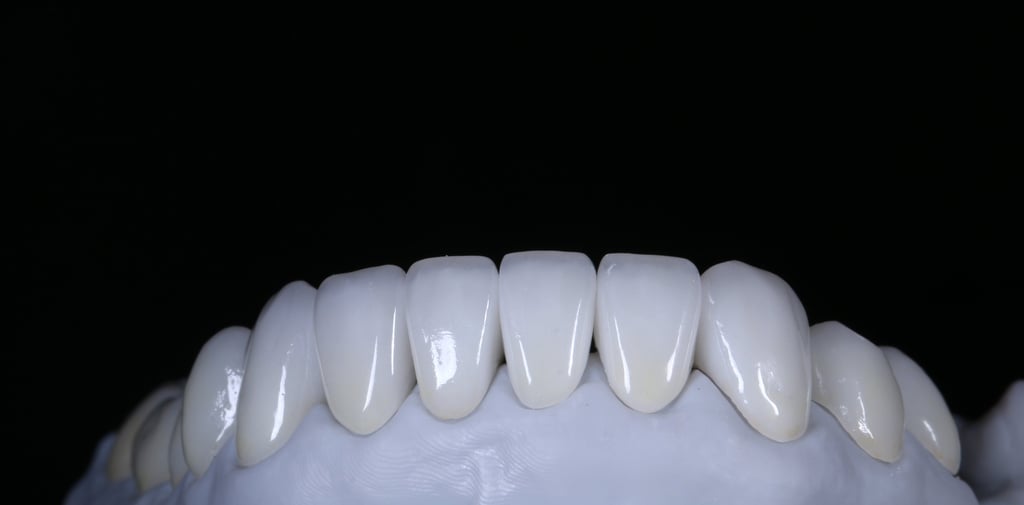
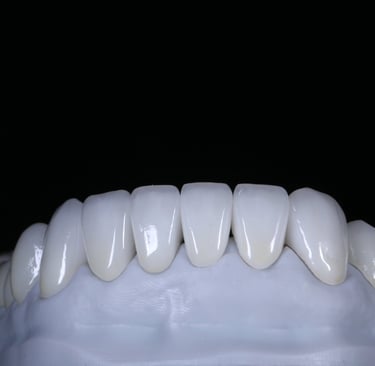
✨ Materials Matter: Exploring the Latest Zirconia and E-max Innovations
The evolution of dental ceramics has fundamentally reshaped restorative dentistry, moving past the compromises of Porcelain-Fused-to-Metal (PFM) to all-ceramic solutions that offer superior aesthetics and strength. Today, two materials dominate the market and represent the pinnacle of modern lab work: Zirconia (Zirconium Dioxide) and Lithium Disilicate (E-max). Understanding the unique properties and ideal clinical indications for each material is crucial for delivering predictable, long-lasting, and beautiful results. Our commitment at the lab is to utilize the latest generation of these materials and leverage advanced CAD/CAM technology to achieve microscopic precision.
The Powerhouse: High-Strength, High-Translucency Zirconia
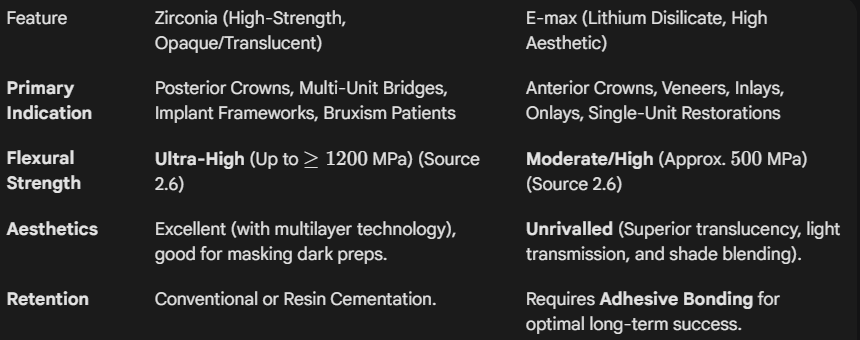
Zirconia has solidified its position as the ultimate material for durability, boasting a flexural strength that can exceed 1,200 MPa. Originally opaque and best suited for posterior frameworks, significant innovations have led to the development of highly translucent, multi-layered zirconia. These next-generation materials, often referred to as 4Y or 5Y, incorporate higher yttria content, which enhances light transmission to mimic natural enamel while retaining remarkable strength, making them viable for both anterior and posterior use. Zirconia is the undisputed winner for high-stress areas.
Key Innovations & Clinical Indications:
Monolithic Zirconia: Fabricated as a single, solid block, this material offers maximum fracture resistance, making it the gold standard for molars, multi-unit bridges, and restorations for patients with heavy occlusion or bruxism.
Layered Zirconia: This option combines a strong zirconia core (framework) with a layered ceramic veneer for maximum aesthetics. This is often the best choice for long-span bridges and complex implant cases requiring both high strength and ideal appearance.
Longevity & Fit: Studies confirm that zirconia restorations, particularly in the posterior region, show high long-term survival rates (up to 94% success at 10 years) and excellent mechanical reliability (Source 2.2, 2.4).
The Aesthetic Champion: Lithium Disilicate (E-max)
E-max, a Lithium Disilicate glass-ceramic, is the material of choice when aesthetics are the paramount concern, particularly in the highly visible anterior region. Its defining characteristic is its remarkable translucency and opalescence, which allows it to diffuse and transmit light much like natural tooth enamel (Source 2.6). This results in restorations that blend seamlessly, offering superior colour-matching and vitality that are challenging to replicate with any other material.
Key Innovations & Clinical Indications:
Unrivalled Aesthetics: E-max is often preferred for anterior crowns, veneers, inlays, and onlays due to its ability to mimic the subtle gradients and depth of natural teeth.
Bonding Strength: With a flexural strength generally around 400-500 MPa, E-max restorations rely on adhesive bonding to the tooth structure, which significantly enhances the restoration’s overall durability and allows for more conservative tooth preparation.
Conservative Dentistry: E-max enables the fabrication of ultra-thin restorations, such as veneers, allowing for minimal-to-no tooth reduction, thus preserving more of the natural tooth structure—a significant advantage for both clinicians and patients.
📢 The Aesthetic Callout
"Every tooth in a man's head is more valuable than a diamond." — Miguel de Cervantes
This timeless quote perfectly captures the invaluable nature of a natural, healthy smile—a principle that drives our lab to use only the most advanced materials to protect and restore our patients' most precious assets.
In Summary: Making the Right Choice
The decision between Zirconia and E-max is not about which material is "better," but rather which one is ideal for the specific clinical situation.
WORKING HOURS
Monday - Friday 8:00 AM - 6:00 PM
Saturday - Sunday 8:00 AM - 1:00 PM
ADDRESS
No. 31-3 (Third Floor), Jalan PJU 5/20E,
The Strand Kota Damansara, PJU 5,
47810 Petaling Jaya, Selangor
+6011-61303061
info.3ddigitallab@gmail.com